DAILY FILM DOSE: A Daily Film Appreciation and Review Blog

Thursday, 8 July 2010

A Single Man

A Single Man (2009) dir. Tom Ford
Starring: Colin Firth, Matthew Goode, Julianne Moore, Nicholas Hoult

****

By Alan Bacchus

Primo fashion designer Tom Ford makes an auspicious transition into filmmaking with one of the best films of last year - a truly mesmerizing, intense and passionate introspective look at love, loss and the barriers to grief for a gay man in the 1960’s. And second go around on DVD, the film holds up admirably.

As the former creative director of Gucci, we all know Tom Ford has style, and indeed the wardrobe is impeccable and precise without being overwhelming. In fact the visual design of the entire film seems to trickle down from George Falconer’s suits and black-rimmed glasses into every corner of Ford’s stunning frames. In fact, it’s the most visually-pleasing film of the year, remarkable considering it’s not in 3-D and there is certainly no blue Na’vi.

Ford’s film is based on the novel of the same name written in 1964 by Christopher Isherwood. And so Ford has the both the benefit of the first person thoughts of a gay man written at the time the story is set, as well as 45+ years of historical context post 1964.

Colin Firth plays George Falconer, an English professor in LA who at the beginning of a November day in 1962, gets a phone call that his partner and lover of 16 years has died in a car accident. The phone call is rendered even more heartbreaking when the family member on the other end of the phone informs him that he can’t go to the funeral, that it's for ‘family’ only.

As typical for many gay men at the time, he has a dual and closeted lifestyle with his true emotions directed inward. Thus, his inability to grieve with true emotion catharsis. George tells himself he just had to get through this day. By carrying around a revolver in his bag suicide would seem to be the end of the path. But when a spry young student takes an interest in him, a ray of light shines downon George offering a glimmer of hope.

‘Revolutionary Road’ makes a good comparison film – the tepid suburban tragedy based on Richard Yates’s acclaimed 1961 novel. But ‘A Single Man’ seems to have gotten everything right that ‘Road’ got wrong. While Road’s examination of suburban fears in post-war America felt out of date and played out, ‘A Single Man’ reflects poignantly on this fearful period in time with historical reflection.

Ford also piggybacks on other films with homosexual themes. Casting Colin Firth seems a concerted attempted to continue a foundation of closeted gay character both actors have established in other films, namely Firth’s in the closet characters from ‘The English Patient’ and ‘Where the Truth Lies’. Same with the casting of Julianne Moore, who brings the scent Todd Haynes’ Sirkian melodrama ‘Far From Heaven’ to her role as George’s faghag.

Ford keeps the narrative simple and clear of salacious plotting, instead coasting elegantly on his searing tone of mystery and melancholy. The presence of George’s keeps the threat of death, or suicide in our minds. And even George’s interactions of other potential lovers, with the context of homosexuality in the 60’s brings another level of fear and intrigue. We can also enjoy the film purely on the level of Ford’s classically composed frames, each of which are museum-worthy photographs. Horizontal lines are consistently and carefully placed in the foreground and background to directs our eyes to Ford’s main character, his single man.

Looking back again at the picture, it's a shame the weakest aspect is it's final moments. George's fate at the very end seems arbitrary, a tacked on denouement which doesn't enlighten anything new about his character or his journey. Still, it's only a mild distaste which goes away quickly, leaving us with the elegant imagery and sound to linger in our memory.

Wednesday, 7 July 2010

Persona

Persona (1966) dir. Ingmar Bergman
Starring: Bibi Andersson, Liv Ullmann, Margaretha Krook, Gunnar Björnstrand

****

By Alan Bacchus

I admit to not having seen many of Ingmar Bergman’s best works. I liked Seventh Seal, but didn’t care much for Cries and Whispers. Persona, on the other hand is a thrilling mind fuck of a film, comparable to works loopy works of David Lynch and Roman Polanski and certainly better than the overrated Antonioni films of the 60’s.

Persona feels very much a product of the 60’s, on a technical level Bergman crafts number of experimental sequences which, with today’s eyes feels more like a parody of obtuse art house experimentation. It’s a stretch to make sense out of the two psychedelic montages – the first which opens the film and the second at the midpoint –but it’s sheer audacity and ambitiousness is thrilling. The opening scene is 3-4mins cooky sequence featuring a cacophony of imagery and sound – at one point we even see an erect penis cut in there - which at first seems completely random but foreshadows the psychological state of the film's protagonist, Alma.

Then the film settles into a traditional narrative. Bibi Andersson plays Alma, a nurse assigned to provide care to an actress Elisabeth (Liv Ullman) who has suffered a mysterious ailment which has rendered her mute. After some therapy in a hospital Alma takes Elisabeth into the country for a peaceful retreat which might just help induce her out of her psychological funk.

Slowly the roles of patient and therapist reverse themselves. As Alma attempts to unlock Elisabeth’s soul she finds herself reveals intimate details of her own personal traumas. In one miraculous scene reminiscent of Nicole Kidman’s startling revelation to Tom Cruise in Eyes Wide Shut, Alma confesses to Elisabeth an orgy which caused her to be pregnant and then have an abortion. As the ‘therapy’ progresses, Alma’s inability to crack Elisabeth’s drives her to madness.

Other than the Eyes Wide Shut comparison, there’s a lot of ‘late career’ Kubrick in Persona. Lars Johan Werle’s brooding atmospheric music creates a spooky tone like that of Kubrick’s The Shining. And even Bergman’s use of long tracking shot brings to mind Stanley's panache with the camera.

Persona is indeed a technical marvel. DOP Sven Nyvkist’s compositions are instantly recognizable as Bergman’s. As in Cries and Whispers his close-ups are framed and his actors blocked with formal and often peculiarly unnatural arrangements in the frame. Bergman loves his profile shots and even within this limited range with precise framing he finds some arresting and stimulating visual compositions.

And the obtuse psychological themes are not that hard to penetrate either. Though it’s a two-hander Alma’s journey is inward, with the presence of Elisabeth serving only as a Rosetta stone for Alma to understand her own emotional problems.

In reading other reviews and analyses of the film, there’s seems to be some confusion about the notion of the title. Some people see a merging or switching of personalities between Alma and Elisabeth – that is, Alma assuming the ‘persona’ of Elizabeth. I don’t particularly see it this way. By the end of the film Alma has assumed the place of patient, after her psychological breakdown, but not in place of Elizabeth. The question of whether Elizabeth ever existed, or if she was a fabrication of Alma’s mind I can’t fully answer, but it’s a mind fuck nonetheless and the work of a master filmmaker.

Tuesday, 6 July 2010

Zombieland

Zombieland (2009) dir. Ruben Fleischer
Starring: Woody Harrelson, Jesse Eisenberg, Abigail Breslin, Emma Stone, Bill Murray

***

By Alan Bacchus

We didn’t really need another self-aware zombie movie. How many times can we redo the same zombie splatter scenes, how many times can a zombie’s head explode before we cease to find it funny? Apparently there’s still more humour to mine from this subgenre. But Zombieland works because it’s barely a zombie movie. Using the familiar post-apocalyptic world of Night of the Living Dead/I Am Legend, director Ruben Fleischer and his screenwriters Rhett Reece and Paul Wernick craft a fun road trip flick with warm characters we want to spend our time with.

For some reason I had missed, all the characters are named after the cities they’re from. First there’s Columbus, a geeky, awkward, type-A Michael Cera type, played by the Cera-like Jesse Eisenberg. He provides the voiceover describing his movements around this wartorn world of zombies which have killed or converted most of the world’s population other than a few pockets of human remnants. Among them is Tallahassee (Woody Harrelson), a Floridian gun totting hick who drives a surprisingly decent pickup truck, and who picks up Columbus wandering along an interstate. The two couldn’t be more different. Columbus has survived by adhering to his own set of zombie rules, which he describes to us in stylish flashbacks. Tallahassee lives by the seat of his pants, by instinct and always behind a doublebarrelled shotgun or a pair of John Woo-style pistols.

Their nemesis comes not in the form of zombies but a pair of spry and intelligent teenage con artist girls Wichita (Emma Stone) and Little Rock (Abigail Breslin). Distrustful of the men, the girls steal Tallahassee’s truck and kidnap them before eventually coming to trust them. Columbus, of course, develops a crush on Wichita who plays hard to get.

Their journey doesn’t seem to know where it’s going until it suddenly ends after a zombie shoot out in an abandoned amusement park. But not before the film’s most memorable scene involving a meet-up with actor Bill Murray in his LA home. Regardless of the ineffectual climax, the Bill Murray scenes are so delightful, the movie doesn’t need to go on after they leave his house.

Murray, in real life, is a notoriously difficult man to corral. And so the mere fact that he is in the film is a miracle not to mention playing a zombified version of himself and even donning Ghostbusters gear to play stream crossing with Woody Harrelson. His wicked dead pan wit bests any of the other gags in the film.

Zombieland also has a two good lead performances from Harrelson and Eisenberg to anchor the journey. I had never really liked Eisenberg in Adventureland, nor The Squid and the Whale, and even though it’s the third or fourth time round for the virginal paranoid anxiety role he feels genuine.

Breaking the film down, there’s not much actually going on the film. Other than the Bill Murray scenes, most of the memorable moments come from the title sequence and flashbacks. Luckily stylish excess is not only forgiven, but encouraged in the zombie genre and Fleischer admirably glosses up his rudimentary script with every stylish trick in the book to satisfying effect.

Monday, 5 July 2010

The King and Four Queens

The King and Four Queens (1956) dir. Raoul Walsh
Starring: Clark Gable, Jo Van Fleet, Eleanor Parker, Jean Wilkes

**

by Alan Bacchus

Clark Gable in one of his last roles stars in this recently DVD-revived 1956 western, directed by studio vet Raoul Walsh, about an escaped desperado who happens upon a desolate town inhabited by four widows and their old gun-toting mama. It makes for a very disposable Western with both Gable and Walsh well past the prime.

Gable is Dan Kehoe, a classic Western protag; he's a womanizing, ethically challenged, lonesome wanderer. The legend of buried treasure watched over by four widows and their mother-in-law is enough to get Kehoe to the ghost town of Wagon Mound in hopes of an easy con. Once there he finds that the gals have more self-respect and honour than he thought, specifically the elder widow (Jo Van Fleet), who packs heat with her mouth and long shotgun.

Walsh and company try their best to skirt the old Hollywood "production code" with coy sexual games, tossing around numerous double entendres. Gable shamelessly goes from woman to woman, trying to score with everyone. I couldn't be sure if we're supposed to find him attractive or not but his slickly greased hair and 'Gone With the Wind' moustache makes him more dirty old man than charmer.

There's a pot of gold hidden somewhere in the town by one of the widows' dead husbands, though much of this discussion is really just a metaphor for the ladies' sexuality, which, for most of the film, they refuse to give up to Kehoe. And so the film becomes an interesting spin on the chauvinistic attitudes of men — a feminist Western where the women always have superiority. It is no surprise the writer is a woman (Margaret Fitts), who crafts her smart screenplay with everything between the lines.

Unfortunately there's no action in the picture and very little suspense. Walsh hopes his star casting and glorious widescreen Cinemascope process, shot by the great Western cinematographer Lucien Ballard, will become the spectacle. With today's eyes it's not, though the DVD transfer is as crisp as they come. Western cinephiles will be more than disappointed, as there are no special features, not even subtitles or a menu screen! Seriously, it's just the roaring MGM lion and the movie.

Sunday, 4 July 2010

Gangs of New York


Gangs of New York (2008) dir. Martin Scorsese
Starring: Leonardo Di Caprio, Daniel Day-Lewis, Cameron Diaz, Liam Neeson

***1/2

By Alan Bacchus

“Gangs of New York” divided audiences in 2002. It received 10 Oscar nominations in most of the major categories. Some critics called the film the Best of the Year. Many, like myself, knowing the storied history of this ‘dream project’ for Scorsese, had high expectations and were disappointed with the result.

Seeing it in 2002 I really wanted to love the film, but couldn’t find anything beyond Day-Lewis’ remarkable performance to cling onto. The Blu-Ray release a couple years ago gave me a new appreciation of the film. After a five-year break “Gangs of New York” has improved greatly and could be considered one of the best films of that year.

"Gangs" opens with a pulsating introduction to the “Dead Rabbits” gang. Liam Neeson, an Irish Priest is preparing to go to battle. His little son, follows him around, watching him gather all his troops and warriors. Their battle tools are unsophisticated – knives, axes, hammers and other bludgeoning objects. As they walk through a series of underground fire-lit caves we still aren’t even sure when or where they are. Is it the Middle Ages? It’s only until after the camera pulls out from the bloody battleground do we realize its Manhattan in 1846.

The opening is backstory to the film when takes place 16 years after this famous battle which finds the priest’s son Amsterdam (Leonardo Di Caprio) returning home to find the killer of his father, the infamous Bill the Butcher (Daniel Day-Lewis). Revenge doesn’t come easy though. Bill has become a de facto gang leader of the community, and with a new alliance with the city’s de facto politic leader, Boss Tweed of Tammany Hall (Jim Broadbent) he is now an untouchable.

The title is a bit of a misnomer. The film isn’t so much about gangs as it is about the city of New York. “Gangs” does what the best epic films do, weigh equally the big story with the small story.

The smaller story is about the evolving relationship of Bill the Butcher and Amsterdam Valone. Daniel Day-Lewis is still phenomenal as Bill. Day-Lewis’ casting and performance in “There Will Be Blood” is clearly influenced by his work in “Gangs of New York”. Day-Lewis is so good it came as a detriment to my first experience with the film. His exaggerated mannerisms chew the scenery and suck all the attention of every scene onto him. Lost in shuffle is a fine performance from Leonardo Di Caprio, who channels Hamlet-like qualities with his character’s indecisiveness. Like the Danish prince, Amsterdam wants to make a statement with Bill’s death. He says, “When you kill a king, you don't stab him in the dark. You kill him where the entire court can watch him die.” And so when Amsterdam becomes one of Bill's disciplines he finds himself admiring his enemy, complicating even further his indecision, and blurring the line between hero and villain.

The ‘bigger’ story is equally fascinating. During the Civil War, when the country was divided between North and South, New York was on its own – not neutral, but autonomous – like a separate colony with the country. And even within the city, everyone was autonomous – which is where the ‘gangs’ in the title comes from. Like the country itself, New York was constantly at war. So "Gangs" is also about the birth of New York and it's relationship with the rest of the country.

The finale, which takes place during the famous draft riots, is a great piece of writing – a scene which brings together the big story and the small story. Just as Amsterdam is about to face off with Bill, the riot starts and the federal police fight back. Amsterdam gets his revenge, but he’s alone with the man, without the fanfare he once foresaw. Bill the Butcher, one of the great villains in screen history dies with honour, neither a hero, nor a villain. Enjoy.

"Gangs of New York" is now available on Blu-Ray from Buena Vista Home Entertainment

Here’s Day-Lewis’ phenomenal dialog scene with Di Caprio:

Saturday, 3 July 2010

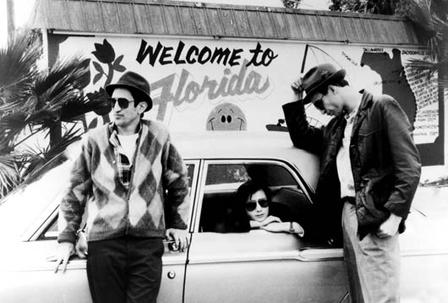
Stranger Than Paradise

Stranger Than Paradise (1984) dir. Jim Jarmusch
Starring: John Lurie, Richard Edson, Eszter Balint

****

By Alan Bacchus

Stranger Than Paradise is as weird as Jim Jarmusch looks, an unconventional, sparse, deadpan indie darling which is mostly about ‘nothing’, yet is full of cinematic freshness, it’s easy to see how a film like this poked the fire of the independent film movement of the late 80’s, early 90’s.

Shot in stark black and white and set among barren apartment buildings, and even more barren New Jersey exteriors, the film works on a number of intriguing levels. Though very little actually happens, if anything, as a theme, the film pokes sharply some holes in the notion of the capitalist dream.

Remember this was 1984, when the cold war ramped up, especially in cinema. In mainstream movies it was Capitalism Freedom vs. Soviet Bloc Communism. Here the central conflict is the relationship of recent Hungarian immigrant Eva (Eszter Balint), and her American cousin Willie (John Lurie). We’re not explicitly told why Eva’s here, or what kind of a life she led in Hungary, but we assume her journey is the same as most of everyone’s else – the achieve the dream. Willie is the ass-end of this dream - a scheming slacker who looks out for nobody but himself.

At every turn Willie seeks to exploit the system – gambling, petty crime, eating from TV dinners. Willie’s buddy Eddie (Richard Edson) is along for the ride and is too passive to challenge Willie’s alpha-status, but he’s quietly attracted to Eva and so he sticks around no matter what kind of bullshit he slings. In fact, it’s been years since both men probably had a girlfriend which makes the introduction of Eva so invigorating. And so when Eva leaves for Cleveland, the void in their lives is palpable which spurs them to go on a roadtrip to find her.

The journey, which takes them from New York, to Cleveland and eventually to Florida, is a metaphor for each of the characters’ search for the real heart of America. Yet for Willie it’s the work that he’s unable to do which would allow the skies to part and thus shine some sun on his life.

It’s a comedy of errors for the trio. Cleveland is a bore and when the two boys foolishly gamble away all their money, it turns their Florida vacation sour. The bizarre ending is a fun bit of revenge for Eva for valiantly suffering through Willie’s tomfoolery, as a woman easily exploiting Willie and Eddie’s virginal desires.

The joys of this film lies in the lengthy silences, deadpan off-reactions, and general feeling of awkwardness which is Jarmusch’s playpen – a style which would influence many of the later works of the other ‘Sundance Kids’. If anything, this is the reason why Stranger Than Paradise is credited as the beginning of this movement.


Friday, 2 July 2010

The Twilight Saga: Eclipse

The Twilight Saga: Eclipse (2010) dir. David Slade
Starring: Kristin Stewart, Robert Pattinson, Taylor Lautner, Bryce Dallas Howard and Billy Burke

*

By Greg Klymkiw

Wading through this vat of raw sewage, I came to the conclusion that only one of two types of people in this world might enjoy watching it - those who have a good time nailing their titties or testicles to the floor and/or completely brain dead vegetables.

Replete with endless, dull, poorly written conversations punctuated occasionally with uninspired, sloppily directed bursts of violence, I can only shake my head in disgust at how low our civilization is sinking. Call me a curmudgeon, assume I am pathetically uncool, accuse me of sounding like my father - I don't particularly care. Today's youth are pathetic - pure and simple. When I was younger, my idea of a vampire movie included great actors like Peter Cushing and Christopher Lee squaring off as vampire hunter and vampire respectively against the backdrop of garish colour schemes. heaving bosoms and atmosphere thicker than Shelley Winters's waistline in the original "Poseidon Adventure".

The first instalment of "Twilight" at least had the virtue of a relatively well-directed and watchable opening 40-or-so minutes. The second helping was a complete mess. Now, due to millions of boneheads watching the previous entries, Hollywood has foisted upon us a third portion of this interminable "saga". I use the word "saga" loosely, if at all, only because the filmmakers have chosen, somewhat erroneously to include it in the title and thus, label it as such. A saga in the traditional sense would normally have something resembling epic qualities, which this film and its predecessors are sorely lacking. In fact, much of the world created by the movie feels - in spite of being set against the great outdoors backdrop of Washington State - strangely claustrophobic. The soap-operatic ruminations of the three central characters belong on afternoon television, not a big screen.

This is not to say that melodrama is out of place in vampire and werewolf tales, it is indeed the backbone of such genre items. That said, there's good melodrama and bad melodrama. The legendary Dan Curtis delivered a consistently creepy and sexy horror soap opera on his daily television serial "Dark Shadows" in the 60s and wowed us with an astounding big-screen version in the 70s called "House of Dark Shadows".

Alas, these three "Twilight" pictures are rooted in revisionism of the clunkiest kind and are so gently precious and tame that they not only drag the whole genre down, but, as stated earlier, reflect the pathetic state of today's youth for buying into such pap.

Again, we who are possessed of brain cels must suffer through the triangle established in "New Moon" involving Bella (Kristen Stewart), the mixed-up mortal with a desire to become a vampire and her romantic obsessions with the pale, thin bloodsucker Edward (Robert Pattinson) and the buff werewolf Jacob (Taylor Lautner). Lautner's pectorals and abs of steel are genuinely impressive and might have even rivalled the milky cleavage content of Hammer Horror pictures if everything else was as awe-inspiring. It's not, however. In fact, the shirtless porn on display is as wasted as John Travolta wearing those delicious form-fitting shorts in the ill-fated "Moment By Moment" where we were forced to succumb to the vomit-inducing sight of him having to swap saliva with Lily Tomlin.

This episode of "Twilight" is especially disturbing since it is helmed by a solid director. David Slade, who delivered the tense, creepy "Hard Candy" and "30 Days of Night", one of the scariest vampire pictures in years, seems largely absent here. The dialogue scenes are covered like a standard dramatic television series, the action sequences are poorly shot and choppily edited and the whole enterprise is so bereft of suspense and style, that one assumes Slade did a paint-by-numbers job in order to secure himself bankability by handing over an unexceptional platter of mediocrity to satiate the boneheads who moronically continue to make this franchise a hit.

About the only thing worth discussing is that I saw the picture in one of two new theatres in Canada that the Cineplex chain is describing as "UltraAVX" - a supposedly new and exciting approach to motion picture exhibition. I'll agree that the digital image is unbeatable - utterly pristine and crystal clear. The sound is also successfully "immersive" as described - in fact, it's so effective that at times, the bass seems to almost make you jiggle in your seat not unlike that of the 70s oddball exhibition feature called "Sensurround ".

The three other major attributes of UltraAVX are less impressive. The wall to wall screen is as advertised, but the top and bottom of the frame is not masked properly and is frankly a bit annoying as it takes one out of the supposedly immersive quality of the image. The bigger, supposedly more comfortable rocker chairs are, in fact, extremely uncomfortable - one sinks into them too deeply and the rocking effect pulls you back too far. In fact, for all the hype about this new seating, leg-room is still an issue and throughout much of the screening, an usher annoyingly paraded back and forth telling people to take their feet off the chairs in front of them. Unfortunately, the first few rows especially forced people into doing this because of the poor design of the chairs themselves. Finally, the reserved seating feature is just a major pain. If you're stuck anywhere near boneheads blabbing or eating with their mouths open (the latter an especially common and disgusting habit in movie theatres these days) then moving to a different seat becomes problematic. Luckily, I prefer the front row (which was empty) and was eventually able to move there after listening to people around me eat their popcorn more grotesquely than pigs at a trough.

Then again, maybe this new "Twilight" experience is a perfect picture to launch this new theatre since the movie is designed to appeal to undiscriminating, swill lapping hogs.

Thursday, 1 July 2010

The Claim

The Claim (2000) dir. Michael Winterbottom
Starring: Peter Mullan, Sarah Polley, Mila Jovovich, Wes Bentley, Julian Richings, Natasha Kinski

****

By Alan Bacchus

Refashioning Thomas Hardy’s novel The Mayor of Casterbridge for the post gold rush Sierra Nevadas along with a not-so-disguised influence from Robert Altman’s snowy western classic McCabe and Mrs. Miller, Michael Winterbottom created an emotional powerhouse of a film, full of brooding drama about greed, gold and deep-rooted Catholic guilt.

It’s also Winterbottom’s most beautiful film he’s shot – a classical and elegant style much different than his street realism fly-on-the-wall films such as A Might Heart or 24 Hour Party People, and on second viewing on the big screen this week at my latest Canadian Cinema in Revue screening (plug plug), it resonates as one of beautiful films of the decade (hell, yeah I said it).

Sarah Polley plays a naive waif Hope Burn who comes to the town of Kingdom Come with her TB-inflicted mother Elena (Natasha Kinski) to meet a long lost ‘relative’ Daniel Dillon (Peter Mullan). But unbeknownst to her, he’s actually her real father. Dillon runs the town like a king and hordes a stash of gold in his bank. Flashbacks recounts and reveals how Dillon’s sold his wife and baby for the deed to the land and thus his ticket to wealth. So much wealth and nothing to spend it on, but when he meets Hope for the first time, instantly a wave of guilt fuels a new zest for life and need for redemption.

At the same time, an ambitious young railroad engineer Dalglish (Wes Bentley) comes into town to survey the surrounding lands, which will ultimate cause the town to move thus nullifying everything Dillon built up in his life.

Winterbottom doubles Alberta’s Rockies for California’s Sierra Nevadas to magnificent effect. In every exterior frame he maximizes the awesomeness of the engulfing mountains, sharp darting evergreen trees which dot the background and the omnipresent snow which gusts around constantly. Remember, it was the year 2000 and CGI was a rarity, so everything in the film is real. Though CGI is able to come very close to achieving the real thing, our minds can sense fakery. And so in The Claim, when we see a young Dillon and Elena climb a mountain in a blustery snow storm the realism on the screen allows the emotions of these scenes to hit us harder.

Winterbottom crafts a number of astounding set pieces which remind us of the grandiose aspirations of David Lean, Sergio Leone and Werner Herzog. The finale, which has Dillon setting all the buildings of his town on fire is a sight to behold, not because Winterbottom actually burned down his entire set, but because it compliments Dillon’s emotional state and completes the atonement for his egregious sins against his family. There’s also the house moving scene, wherein Dillon, at his most ambitious like Herzog’s Fitzcarraldo, wills the impossible into being, steering a team of men who literally pull his house to Elena as a gift of his rekindled love. It’s also an impossible romantic moment which seals Dillon’s last courtship of his ex-wife.

And the three of four surveying scenes taking us into the Albertan and Colorado valleys of where Dalglish charts the new path of the railroad, are no less spectacular. The last of which features a trip on a vintage 19th century railroad through a curving corridor of stunning beauty.

The Claim resonates beyond the mere beauty of what’s put on the screen. Michael Nyman’s masterpiece of a score send the film into the stratosphere, going way over the top in the tradition of the classic Morricone scores composed for Sergio Leone. The moral complexities of Dillon’s journey is the stuff of great storytelling – though credit is due here to Thomas Hardy, Winterbottom’s brings it all to bear with a power only great filmmakers could do.

The pulse of the film beats all the way to the final frames. The last shot, a stunner, sums up the all consuming power of wealth which so easily corrupts the feeble minds of men.

In a new era of epic filmmaking where elements like snow, fire, background actors are ‘enhanced’ with computers, The Claim feels like a throwback epic, and perhaps the last of its kind.

Wednesday, 30 June 2010

Please Give

Please Give (2010) dir. Nicole Holofcener
Starring: Catherine Keener, Oliver Platt, Rebecca Hall, Amanda Peet

**1/2

By Alan Bacchus

Please Give is one of those ensemble character films digging deep into the lives and problems ordinary people who could be your friends and neighbours. In this case director Holofcener paints a portrait of a group of middle class Manhattanites and their interrelated domestic problems not that far removed from any of us slightly neurotic self-analytical reasonably secure yuppie movie goers.

This isn’t the stuff of high drama, or high stakes, instead the appreciation and enjoyment of the picture relies on the audience’s ability to fall in love with Holofcener’s characters and identify with their moral dilemmas.

Holofcener centres on Kate (Catherine Keener) and Alex (Oliver Platt) a couple who run a used furniture business in NYC, and who ply their trade off the remnants of elderly persons who have died and thus have furniture to unload. One of Kate’s goals is to expand into the neighbouring unit which is occupied by one of the types of elderly women who she chases for merchandise. Though Kate is respectful and honest, she does harbour some guilt for ethical dalliances, which fills her with a need to ‘give back’ (hence the title). Whether it’s giving change to homeless men on the streets or becoming a volunteer caregiver to mentally challenged kids Kate needs some cleansing.

Her husband Alex doesn’t really help. He’s charming but self-involved and lacking an emotional attachment to his wife. So it’s no surprise when he picks up an affair with Mary (Amanda Peet) the shallow tan-orexic daughter of his elderly neighbour. Mary’s sister Rebecca (Rebecca Hall) is going through her own very mild emotional crisis having to take care of her elderly grandmother and manage the superiority complex of her sister. These moral complications are all held internally within the characters without the expected outbursts, confrontations, or dramatic reversals of fortune.

Holofcener applies a palpable sense of American middleclass urban realism, like a female Alexander Payne film. Holofcener’s film is unfortunately not nearly as funny. Without satire, absurdity, parody, or slapstick the laughs are subdued greatly, instead I found myself ‘kinda smiling’ at situations that were mildly light hearted without producing actual laughter. Does that count as funny? I dunno, but other critics did.

While there’s nothing false, forced or contrived my appreciation of Please Give is as boisterous as the gentle arc of its characters. The very slight emotional journey Kate/Alex/Rebecca et al go through is perfectly summarized in the metaphor of Kate’s teenaged daughter’s search for the perfect pair of jeans. After going through the picture complaining about being fat and not fitting into the jeans she wants, in the end Abby’s pulls herself into a snug new pair of pants. She is blissful and content. The closure of these characters will not light any fires, but we feel a mildly warm glow of content.

Tuesday, 29 June 2010

A Perfect Getaway

A Perfect Getaway (2009) dir. David Twohy
Starring: Steve Zahn, Mila Jovovich, Timothy Olyphant, Kiele Sanchez

**1/2

By Alan Bacchus

There’s much to admire and much to groan about A Perfect Getaway, David Twohy’s vacation thriller, which at first glance would appear to be throwaway genre pic, but its decent receipts and tempered praise suggested more. On one hand, it’s a smart genre-aware thriller which has the ability to genuinely surprise and shock us, on the other, a transparent exercise in cinematic reverse engineering and thus ultimately the empty throwaway picture we expected.

By the way... If you haven’t seen the film, best not even read further, because some major plotting and SPOILERS needs to be discussed in order to analyse this picture.

Now back to the film... when I mean ‘reverse engineering’, I mean the whole purpose of this film’s existence is its third act twist, which either comes as a total and thus thoroughly satisfactory surprise, or as an exercise in futility to astute audiences who catch on early.

Twohy, a veteran writer/director of high concept but unmemorable films like ‘Pitch Black’, 'The Chronicles of Riddick', and ‘The Arrival’, is clever in setting it all up. First, the casting of Steve Zahn and Timothy Olyphant. Zahn, the highly recognizable character actor known for his affably goofy and geeky roles, versus the menacing and brooding presence of Olyphant set us up for a classic confrontation of good and evil.

Early on, Twohy establishes the honeymooning Cliff and Cydney (Zahn and Jovovich), are a couple of naive vacationers in Hawaii throwing around money, talking loudly and thus making themselves a target for a serial killing couple that has been stalking the islands.

Cliff and Cydney meet Nick and Gina (Olyphant and Sanchez), Nick being a highly nosey and overly friendly hiker with large eyes that never seem to blink. He’s so obviously the bad guy, right? Not necessarily. Twohy teases us with a number of potential baddies. There’s another wandering couple, a guy with nasty looking mouton-chops, tattoos and chiselled hard body who speaks in raspy tones. He’s seems pretty evil too. We also see a local moustache-twirling Hawaiian dude who coyly watches Cliff taking out his wad of cash from his wallet to pay for his hiking permits. He’s a potential threat too. So we three potential baddies, with Twohy hoping our attention is distracted by oscillating between these three red herrings.

Back to the casting... Hiring Zahn and embellishing his meek persona, nervous anxiety and dressing him in nerdy blackrimmed glassed enhances this distraction. At the same time, Twohy’s lack of subtlety with these base characterizations might also have smarter audiences think twice about what actually is going on. Eventually it’s revealed that Zahn and Cydney are the mysterious serial killers, a twist, which I caught on late in the movie, and thus didn’t get the full shock value intended by the director.

Under Twohy’s ‘either/or’ treatment of the film – that is, either you guess the ending or you don’t – the picture clearly works for those who don’t guess the ending and doesn’t for those who do. Arguably it didn’t have to be this way. In the final act, after the big reveal Twohy’s direction takes a sudden turn for some overly stylized and laughable action sequences. The lengthy flashbacks run on too long, and betray the cleverness of Twohy’s set-up, essentially dumbing the picture down and telling the audience how he tricked us. The violence is also ramped up for some gore, which is awkward and doesn’t fit the tone of the rest of the picture.

And so, I have to sit on the fence on this one, leaning neither for nor against. Twohy’s mix of genre-savvy cleverness and self-awareness is liberating, but his blockhead inconsistent direction betrays his own writing.

Monday, 28 June 2010

Sideways

Sideways (2004) dir. Alexander Payne
Starring: Paul Giamatti, Thomas Haden Church, Virginia Madsen, Sandra Oh

****

By Alan Bacchus

“Sideways” was a great success story. The modest comedy without any particular marketable hook other than great characters turned critics’ heads around in 2004 and garnered a well-deserved Best Adapted Screenplay Oscar as well as nominations in most of the major categories.

With five years of hindsight, the film the ages well and packs as much of an emotional punch as it did back then. At its heart its a unique male buddy film – the word du jour would be a ‘bromantic comedy’. Two guys bonding on a weeklong roadtrip in Napa Valley. Miles (Paul Giamatti) is a forty-something divorcee and struggling author. He has arranged a relaxing week of wine-tasting with his buddy Jack (Thomas Haden Church), who’s about to get married. Jack's agenda is for he and Miles to get laid – specifically Miles whom he's desperate see to break out of his two-year long post-divorce depression.

Jack, as wingman, brokers a four-way date with a pair of attractive middle-agers and fellow wine connoisseurs Maya and Stephanie (Virginia Madsen and Sandra Oh). While Stephanie and Jack’s libidos explode immediately Miles’ courtship of Maya is carefully, slowly revealing his neurotic fears and painful regrets. But Jack’s heinous lies burden both relationships resulting in even more painful heartbreak.

Characters rules in "Sideways" and each actor inhabits their skin with complete honesty. In some way or another we can all relate to their situations. For Miles, his internal pain is a lifelong pattern of failure – career failure and relationship failure. In addition to complete self-absorption, to replace his emptiness Miles obsesses about everything to do with wine. Jack as the womanizing pick-up artist is both the angel and devil on his shoulder. While his philandering behaviour is completely reprehensible his devotion to his best mate is admirable. It’s a classic male relationship, which Payne characterizes with perfection.

Payne has remarkable control of his tone, moving fluidly between somber reflections on life to absurd comedy and all the shades of grey in between. Aiding this is Payne’s modest camerawork, unstylish and unassuming, but hardly rudimentary. Perfect framing and camera placement, subtle camera moves emphasize and aid all the poignant and comic moments with pinpoint accuracy. Rolfe Kent’s music is equally unflashy but so important to Payne’s tone, a gentle mix quirky and melancholy.

From the four films by Payne and his co-writer Jim Taylor, they could be argued as one of the great writing duos in film comedy. From “Citizen Ruth”, “Election”, “About Schmidt” and “Sideways” (as well as marvelous segment in “Paris Je T’Aime”) this eight-year examination of ordinary middle class America and the variations of character neuroses reminds us of Woody Allen’s remarkable output from late 70’s to the late 80’s.

Sunday, 27 June 2010

The Yes Men

"The Yes Men" (2003) dir. by Dan Ollman, Sarah Price and Chris Smith
Starring: Jacques Servin and Igor Vamos

**1/2

By Blair Stewart

Two men on a stage for a World Trade Organization conference somewhere in Stockholm or Cleveland gloss over collusion between business interests and local governments with a steep price paid by the countries of the third, second (Cuba? North Korea?), and occasionally first world.

Blah-blah-blah-unsafeworkingconditionsandabunchofchinesefolksdie-blah.
Yadda-yadda-industrialwastedumpedintoalake-yadda.

Then two other men get up and in a factually roundabout method that might segue into gold lame bodysuits and edible shitburgers say what the intentions of the W.T.O. and their global enablers really are.

I'd much prefer watching the latter. The W.T.O. would not.

Taking the prank-conscience activism of 'Adbusters' with a splash of the Situationists and swinging a wrecking ball at globalization, "The Yes Men" are a pack of good samaritans shaming corporation flunkies worldwide. An eponymous documentary on the two main wise-asses, 'Mike Bonanno' (Igor Vamos) and 'Andy Bichlbaum' (Jacques Servin), who go about these conferences nodding, shaking hands and smiling in suits until they get up on stage and stir shit up with their truth-telling. They've accomplished this by posting fake websites with subtle jibes towards the corporate world. Predictably by not reading-deeper this has lead to trade organizations inviting our heroes to conferences all over the globe, with the occasional appearance on primetime news. Poker-faced, the Yes Men argue in preference towards 'remote-controled foreign labour' and recycling fast-food burgers so we can sell them back to Bangladeshians. An inflatable phallus even puts on a show for the crowds.

Overwhelmingly in these situations 'Bichlbaum' as his alter-alter ego "Hank Hardy Unruh" (love that name) is met only with blank faces from the donkeys he's pinning a tail on.

A chilling reveal on the inhumane nature of capitalism while also being an enjoyable lark of a documentary, "The Yes Men" isn't exceptional in part due to an ending that peters out and the slight reveal on the real lives of the subjects. I found my latter issue surprising as co-directors Chris Smith and Sarah Price were responsible for such highly-praised works as “American Movie” and “Home Movie”, especially with “American Movie” digging right under the skin of its sad-sack dreamer Mark Borchardt.

Despite these qualms the anti-W.T.O. story is told with a lighter touch than Michael Moore's to which I am grateful, and I look forward to watching the sequel “The Yes Men Fix the World”, which involves the Halliburton-designed 'SurvivaBall', used to combat the effect of climate change. But of course.

Saturday, 26 June 2010

The White Ribbon

The White Ribbon (2009) dir. by Michael Haneke
Starring Christian Friedel, Ulrich Tukur and Ursina Lardi

****

By Blair Stewart

In the traditional German kids collection 'Der Struwwelpeter' a thumb-sucking child has his digits cut off by giant scissors to learn a lesson, and another won't eat his soup until he starves to death. If you don't abide by the rules the rules will be taught sharply. In hindsight the subtitle of "A German Children's Story" for the Cannes-winning "The White Ribbon" is most appropriate for this film.

The village of Eichwald sits under a heavy silence as it experiences a fit of 'incidents' in 1913-1914. Tripwire is laid for the local Doctor on horseback; a peasant dies in a grain silo accident, children are found in the nearby forest savagely beaten. As is standard in a Michael Haneke film the threat(s) won't be fully revealed, but the private skeletons of the locals and a few clues will come tumbling out.

Looming behind the tension in the community is Europe's Great War holding its breath. The young schoolteacher is our protagonist (Christian Friedel), who also acts as an uncertain old narrator looking for reason in the madness within and beyond the village during his lifetime.

His fortunes in the town will rise and fall over the seasons along with the strict Priest, the Doctor, a twittering pack of young and the darkly muttering peasants toiling under the Landbaron(Ulrich Tukur from "Seraphine"). This would make for a standard thriller with a sadistic bent if it weren't for a number of factors coming together superbly, none more so than the fantastic performances of children in several roles vital to the story.

Featuring an awkward and surprisingly sweet romance unusual for his work ("Benny's Video" and "Funny Games" would make for terrible family viewings unless your parents are humourless psychoanalysts), Haneke otherwise uses his talent for hidden menace where the most violent on-screen action is a cabbage fields destruction. Stating his intention for "The White Ribbon" as an exploration of terrorism in its many forms and consequences, the Austrian director's black-and-white setting has elements of Clouzot's classic "Le Corbeau" and Miller's "The Crucible", all containing similar themes of secrecy and retribution.

While well over two hours long the story never dragged for me, with a script of over twenty characters carrying a story that could have been adapted from an unknown classic novel. A work of repression made with the confidence of a director in command of his form, "The White Ribbon" joins Haneke's "Hidden" as the best film of his career, and one of the finest of the past decade.

'The White Ribbon' is available on DVD and Blu-Ray from Sony Pictures Home Entertainment

Friday, 25 June 2010

Cyrus

Cyrus (2010) dir. Jay and Mark Duplass
Starring: John C. Reilly, Jonah Hill, Marisa Tomei, Catherine Keener

***

By Alan Bacchus

It’s exciting to see the staunch indie duo, the Duplass Bros, who have created their own brand of dramatic comedy step up their game. With Fox Searchlight on board and Ridley and Tony Scott on their backs, The Duplasses have their biggest toybox to play in. They’re able to afford their first ‘Hollywood’ cast, employing McKay/Apatow players John C. Reilly and Jonah Hill as rivals for the affection of single mother Marisa Tomei.

Despite whatever increase in budget these guys were allowed everything else in the film seems to adhere to their usual modus operandi. The Duplasses use simple domestic relationships with an tinge of the absurd to create a quirky but sentimental heartwarming comedy about the fine line between love and war.

Reilly plays John, a late 30-something divorcee who just can’t seem to move on life. His world crashes fully when his ex-wife (Catherine Keener) reveals she’s about to get married. John goes on a wild embarrassing drunken bender at the engagement party, but also happens to meet and impress hottie Molly (Marisa Tomei). Sex comes quickly and so does true love which both people are not afraid to admit to each other. One problem… Molly lives with her slightly deranged man-boy son Cyrus (Jonah Hill) whom Molly is careful integrating into their relationship.

John tries his best to make friends and so does Cyrus, but John notices a particularly strange relationship between mother and son. They literally and figuratively have an open door relationship, where even the most delicate of subjects is not out of bounds. John is completely shocked when Cyrus boldly jokes to him, with poker-faced deadpan if he’s fucked his mother yet.

As John negotiates his way into the relationship he discovers a dubious game being played by Cyrus to get John to break up with Molly. Stubbornly John is not willing to back down resulting in an absurd childish and immature cold war.

Using a creepy false congeniality and a great psychopath stare, Jonah Hill wonderfully creates agonizing awkwardness between the trio. The brothers hold this stalemate out long enough before giving John the chance to pull back the veil of deception and get into the meat and potatoes of the conflict. Under anyone else’s watch in Hollywood, the battle between Cyrus and John would have started much earlier in the film, and heightened dramatically for broader comedic effect. But the brothers stay true to the ‘M’ filmmakers in them and draw out the agony of politeness with each other long enough to make the truth more satisfying.

Cyrus is not completely cynical like say, ‘The Puffy Chair’, there’s a warm tenderness which emerges, not unlike ‘Baghead’. Unfortunately what the final verdict comes down to is that the brothers have just not made their film funny enough to win over non indie-art-house audiences, but the genuine optimism in love and romance makes ‘Cyrus’ a modest though unmemorable addition to their filmography.